Car Sun Film Guide for India: Types, TSER Ratings, FASTag Safety & Kerala Legal Limits
How Are Car Sun Films Actually Classified in the Indian Market?
Most guides classify sun films as "dyed", "metallic", "carbon", and "ceramic" — this is the international classification used by global retailers. In practice, the Indian window film market uses a different, more specific set of terms that reflect how the film is actually constructed and how it performs in tropical conditions.
The accurate Indian market classification for window films sold here is:
- Glue Dye film — dye in the adhesive layer only
- Chip Dye film — dye uniformly embedded through the film body
- Deep Dyed film — dense, light-absorbing dye through the full film stack
- Nano Ceramic / Ceramic film — non-dye technology using nano-ceramic particles
Understanding these distinctions matters because the degradation behaviour, heat performance, and longevity differ significantly — especially under Kerala's high-UV tropical conditions.
What Is Glue Dye Film — and Why Is It the Worst Option?
Glue dye film is the lowest tier of window film sold in India. The colouring is embedded only in the adhesive layer, not in the film body itself. When UV breaks down the adhesive — which it does aggressively in Kerala's climate — the colour fades unevenly and the film takes on a purple or pink cast.
This is the "purple window" you see on cars 2–3 years after a cheap tint job. It is not the film fading — it is the adhesive dye degrading.
Lifespan in Kerala conditions: 12–24 months before visible discolouration.
Heat performance: Poor. Glue dye only absorbs heat — it cannot reflect it — and the absorption creates a warm zone at the glass surface that partially radiates inward.
Recommendation: Avoid entirely. The low upfront cost does not justify the rapid degradation.
What Is Chip Dye Film?
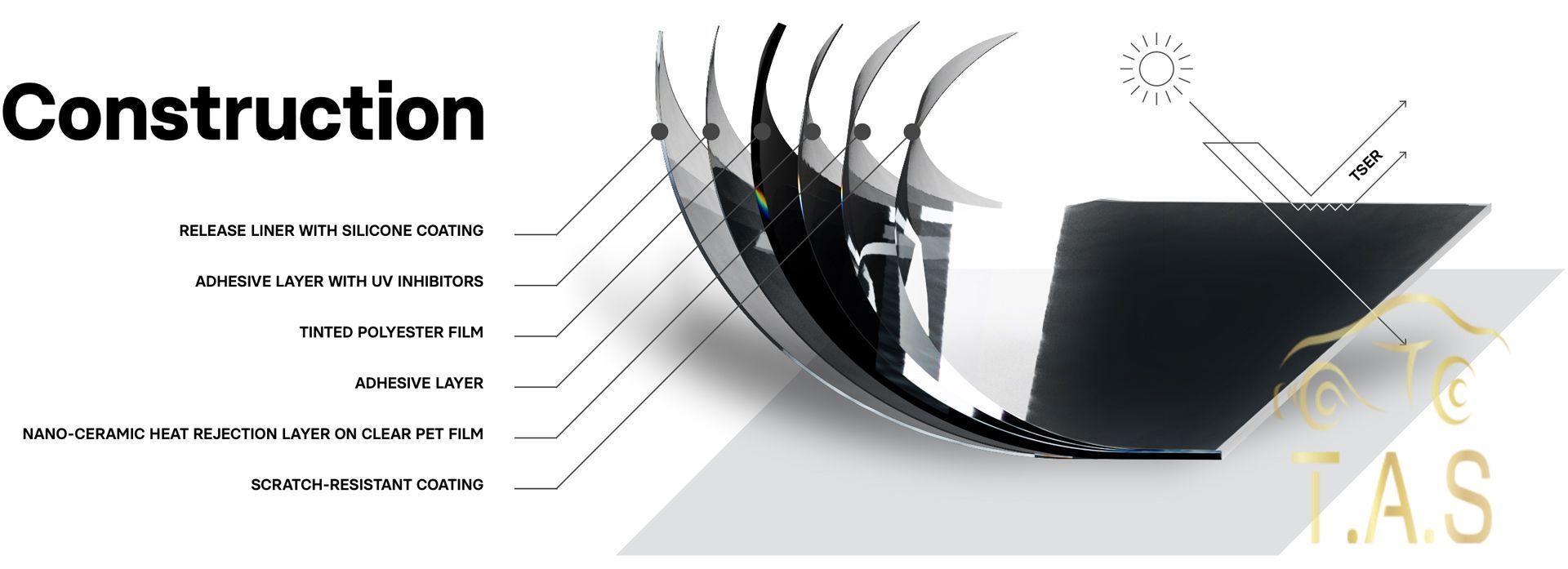
Chip dye film contains uniform dye particles (chips) throughout the film body rather than just the adhesive layer. This distributes the UV absorption load across the full film thickness, meaning it degrades more evenly and more slowly than glue dye.
Lifespan in Kerala conditions: 3–5 years before noticeable fading.
Heat performance: Moderate. TSER (Total Solar Energy Rejection) typically 35–50%. Better than glue dye but still relies on absorption rather than reflection or rejection.
Signal safety: Yes — no metal content, FASTag and GPS unaffected.
Recommendation: Entry-level choice for secondary vehicles or short-term ownership. Acceptable for privacy; limited for heat rejection.
What Is Deep Dyed Film?
Deep dyed film uses a high-density dye layer through the full film construction. The denser dye creates a darker appearance and better initial heat absorption compared to chip dye. The key distinction is the density of the dye load, which also means the film absorbs more UV and converts it to heat within the glass zone — this can be felt as warmth at the glass surface.
Lifespan in Kerala conditions: 4–6 years.
Heat performance: TSER 45–55%. Provides visible heat reduction compared to no film, but less effective than ceramic.
Signal safety: Yes — metal-free.
Recommendation: Acceptable for rear windows where TSER is more important than clarity. Not ideal for front windows or maximum heat rejection.
What Is Nano Ceramic / Ceramic Film — and Why Is It the Right Choice for Kerala?
Ceramic film uses nano-ceramic particles embedded in the film to reflect and reject solar energy rather than simply absorbing it. The absence of dye means no colour degradation — ceramic films remain optically stable over their full lifespan.
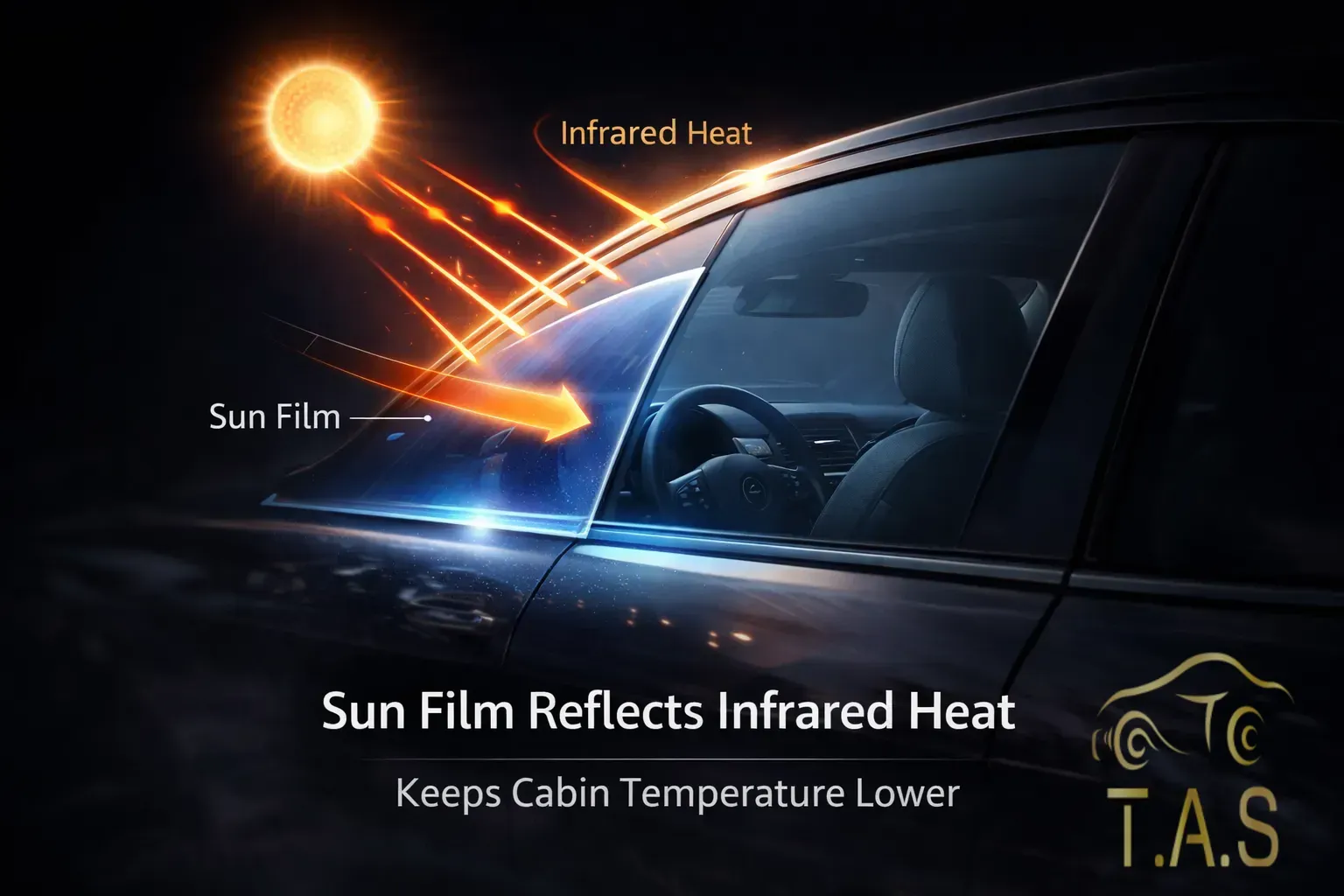
This is not a marketing term. The ceramic particle technology functions differently from dye-based films at a physics level: dye films absorb infrared and re-emit some of it as heat; ceramic films reflect infrared before it penetrates the glass.
Lifespan in Kerala conditions: 8–12 years with no colour change.
Heat performance: TSER 55–72% for standard ceramic; 65–80%+ for advanced IR-rejection ceramic variants.
Signal safety: Yes — ceramic particles are non-conductive. No interference with FASTag, GPS, or mobile signal.
Optical clarity: Highest of all film types — ceramic film on the front windscreen maintains better clarity than any dyed alternative at equivalent VLT.
Recommendation: The only film type we recommend for front windows and for anyone intending to keep the vehicle 4+ years in Kerala's conditions.
Does Sun Film Block FASTag or GPS Signal?
This is one of the most common questions we receive since FASTag became mandatory in India.
FASTag uses 865 MHz RFID (UHF radio frequency). Signal interference depends entirely on whether the film contains metal.
| Film Type | Metal Content | FASTag Compatible | GPS Compatible |
|---|---|---|---|
| Glue dye | None | Yes | Yes |
| Chip dye | None | Yes | Yes |
| Deep dyed | None | Yes | Yes |
| Nano ceramic | None (ceramic particles, not metal) | Yes | Yes |
| Metallic / Sputtered metal | Metal layer | No — blocks RFID | Reduced |
| Carbon hybrid (with metal layer) | Sometimes | Check manufacturer spec | May reduce |
All dye-based and all ceramic films are FASTag safe. The only films that block FASTag are metallic (sputtered metal) films — which are increasingly uncommon in modern professional installations.
At TAS, all films we install are FASTag-compatible and GPS-transparent. We do not install sputtered metal films on vehicles with FASTag or ADAS (advanced driver assistance sensors).
Full TSER Comparison Table: Indian Market Film Types
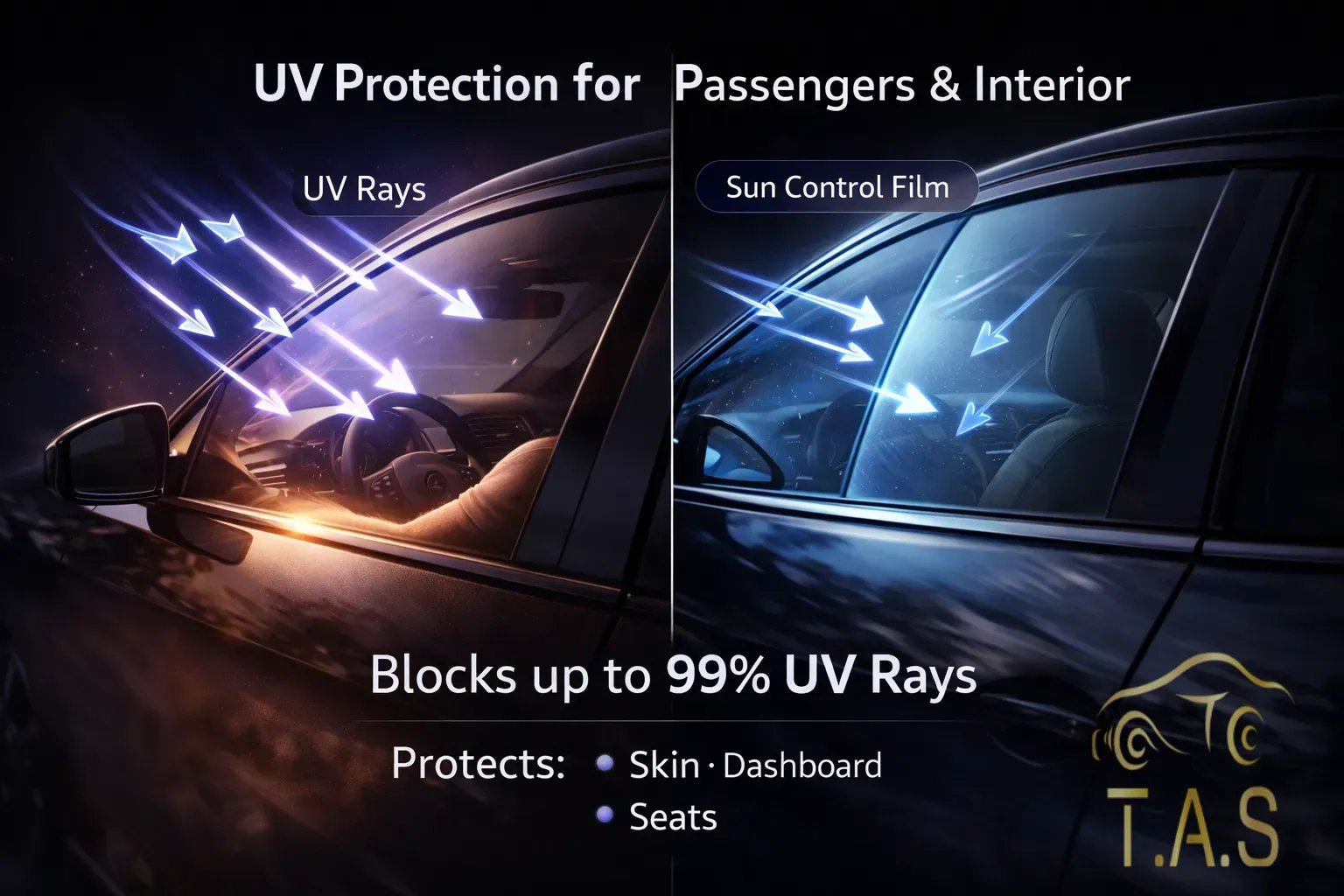
TSER (Total Solar Energy Rejection) is the most useful single metric for evaluating sun film heat performance. It measures what percentage of the total incoming solar energy (including UV, visible light, and infrared) is rejected by the film.
| Film Type | TSER | IR Rejection | UV Rejection | Cabin Temp Reduction | Lifespan (Kerala) |
|---|---|---|---|---|---|
| Glue dye | 20–35% | 20–35% | 85–95% | 2–4°C | 1–2 years |
| Chip dye | 35–50% | 35–50% | 95–99% | 3–6°C | 3–5 years |
| Deep dyed | 45–55% | 45–60% | 99% | 4–7°C | 4–6 years |
| Nano ceramic (standard) | 55–68% | 60–80% | 99%+ | 7–11°C | 8–10 years |
| Nano ceramic (IR-enhanced) | 65–80% | 80–99% | 99%+ | 10–15°C | 10–12 years |
Note: TSER values depend on specific VLT selected. Higher opacity (lower VLT) generally increases TSER within each film type. Values above represent mid-range VLT variants.
What Are the Legal VLT Limits in Kerala?
VLT (Visible Light Transmission) is the percentage of visible light that passes through the glass + film combined. Indian law specifies minimum VLT, not maximum darkness:
| Window Position | Minimum VLT Required (Motor Vehicles Act) |
|---|---|
| Front windscreen | 70% VLT |
| Front side windows (driver + passenger) | 50% VLT |
| Rear windscreen | 70% VLT |
| Rear side windows | 50% VLT |
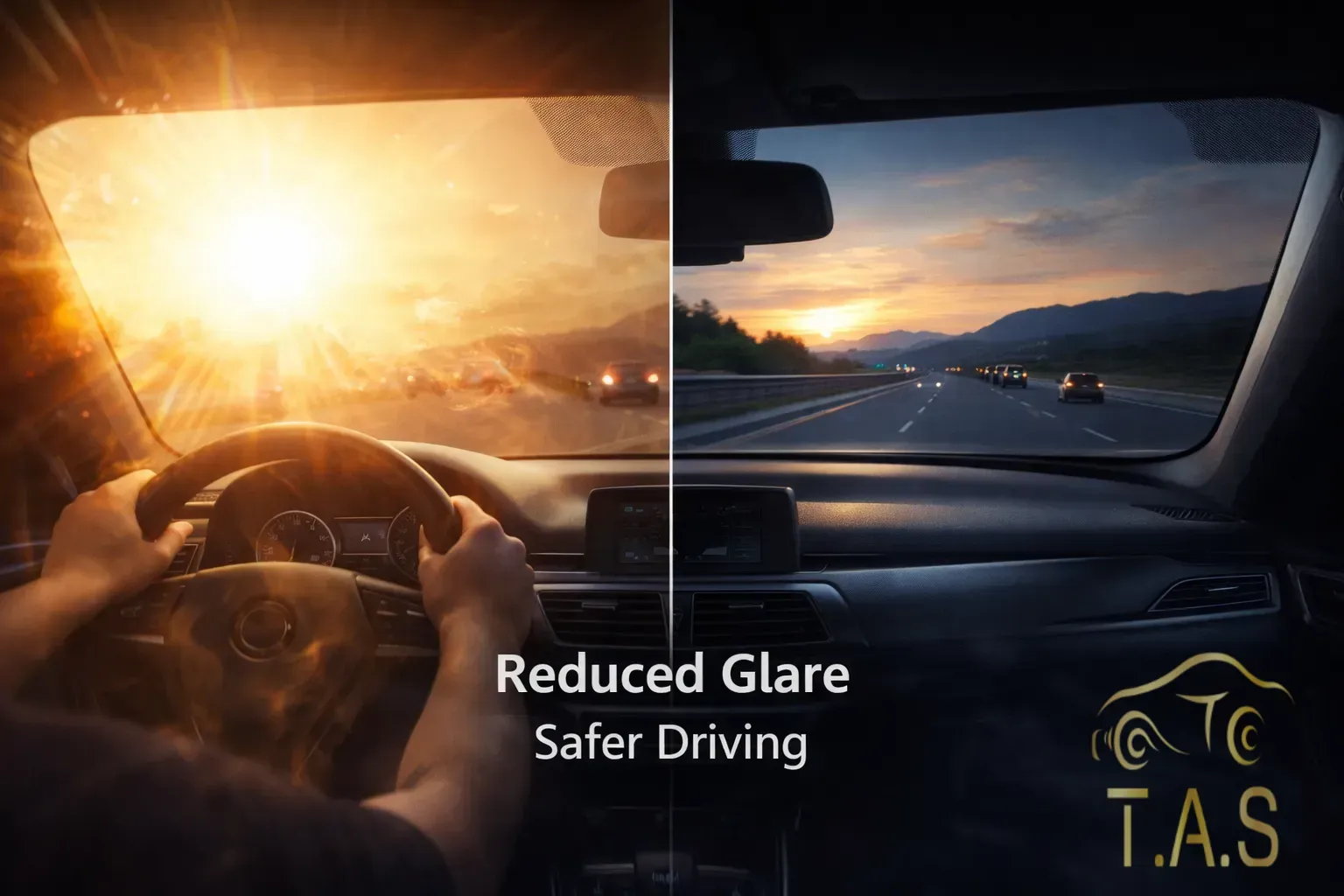
Important for film selection: VLT is measured as the combined glass + film transmission, not the film alone. Most car glass already has 70–75% natural VLT. Applying a film rated at 70% VLT typically brings the combined total to approximately 50–55%, which falls below the 70% legal requirement for front windows.
For front windows to remain within commonly referenced visibility limits, you generally need a very light film so the combined glass-plus-film transmission stays high. In practical terms, obvious dark tinting on front windows is difficult to reconcile with those thresholds.
Our recommendation for front windows: - Front windscreen: light ceramic film (80–90% VLT film rating) for UV protection and minimal heat rejection — no visible tinting - Front side windows: choose the lightest film that still keeps the combined glass-plus-film VLT within the commonly referenced threshold - Rear windows: prioritize overall visibility, your privacy target, and current local interpretation before finalizing film shade
Why Does Kerala's Climate Specifically Favour Ceramic Film?
Kerala's hot, high-UV climate puts more stress on low-quality films over time. Dye-based films generally age faster than better premium constructions when exposed to repeated sun, heat, and washing cycles.
Premium ceramic constructions are generally marketed for better long-term stability, clarity, and heat management than basic dyed films. Actual lifespan still varies by product line, glass condition, installation quality, and aftercare.
Additionally, Kerala's mix of high heat, humidity, and monsoon exposure makes adhesive quality and installation quality more important than film darkness alone.
What Sun Film Does TAS Use?
At TAS Detailing, we install nano ceramic window films from established brands. Our range:
- Ceramic Standard — Solid TSER performance, good clarity, and signal-friendly construction
- Ceramic Premium / IR-Enhanced — Higher TSER, stronger IR control, and longer-term premium positioning
We do not install glue dye films. We can install chip dye or deep dyed films on request for secondary/older vehicles — but we are transparent about the lifespan and degradation timeline when we do.
Related Service
Sun Film Trivandrum — Ceramic and Safety Glazing Options
Professional sun film at TAS Detailing Studio, Trivandrum. Ceramic, chip dye, and safety glazing films from ₹13,000. VLT-guided consultation and FASTag-compatible film options.
Frequently Asked Questions on Sun Film
Does sun film affect ADAS sensors like lane assist or adaptive cruise? Yes — film on the front windscreen can potentially affect camera-based ADAS systems. We recommend not applying any film to the windscreen ADAS sensor zone (typically a 20–30 cm band at the top-centre of the windscreen). Ceramic films generally cause less interference than metallic films for radar-based systems.
Can I install sun film on a new car's factory-tinted glass? Yes. Factory tinting is usually a body-tinted glass that has inherent VLT of 65–70%. Adding a light ceramic film (80%+ rated) will bring combined VLT to approximately 52–58% on rear windows while staying within range on fronts. Always verify combined VLT with your installer.
Will sun film reduce my car's A/C load? Yes, measurably. A premium ceramic film with 10–15°C cabin temperature reduction means your A/C reaches comfort temperature faster and cycles less frequently. Real-world fuel savings of 5–8% on A/C-heavy driving are achievable in Kerala's summer.
How long before I can roll windows down after installation? Wait 72 hours minimum before rolling windows down. The adhesive needs curing time. Rolling windows too early can shift the film edge and create lifting.
What happens if I use a cheap film and it goes purple? The only fix is full removal and reinstallation. Film removal requires heat (heat gun) and chemical adhesive release — done incorrectly it can damage the defroster lines on rear glass. Have it done professionally.
Quick Decision Guide: Which Film for Your Situation?
| Your Situation | Best Film |
|---|---|
| Budget-focused, rear windows only | Chip dye or deep dyed at rear; ceramic at front |
| Daily driver, keep 3+ years | Nano ceramic throughout |
| New car, long-term ownership | Nano ceramic (IR-enhanced if budget allows) |
| FASTag + GPS active | Any dye or ceramic — avoid metallic |
| ADAS-equipped car | Ceramic only; avoid front windscreen coverage over sensor zone |
| Maximum heat rejection, premium car | Ceramic IR-enhanced |
Related Service
Compare Sun Film Options — Trivandrum
Side-by-side comparison of all sun film types offered at TAS. Filter by heat rejection, VLT, price, and warranty. Find the right film for your car in under 2 minutes.