PPF vs Ceramic Coating: Which Is Better for Your Car in Kerala?
What Is the Difference Between PPF and Ceramic Coating?
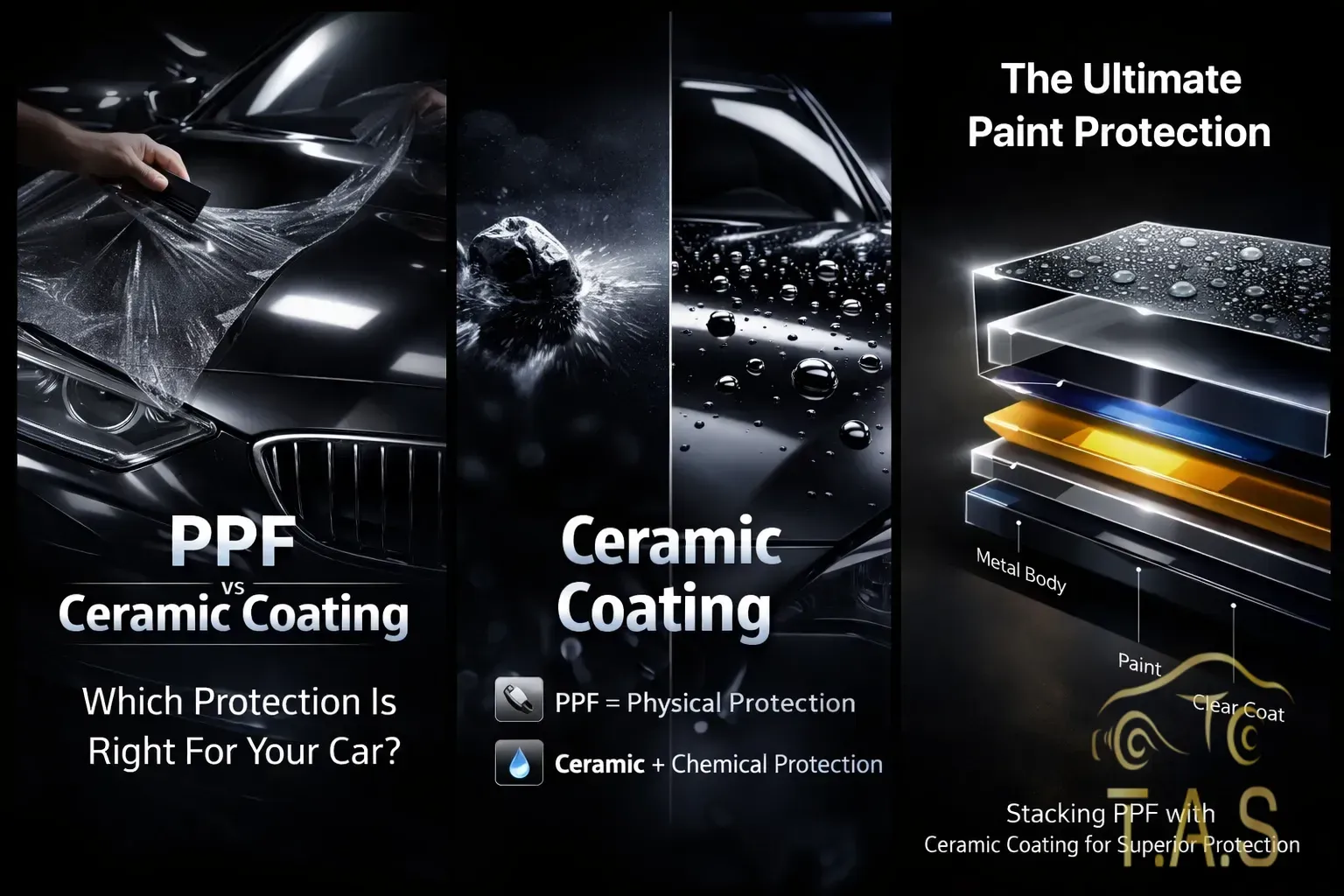
This is the most common question we get at TAS, and the honest answer is: they protect against different things. Comparing them directly misses the point.
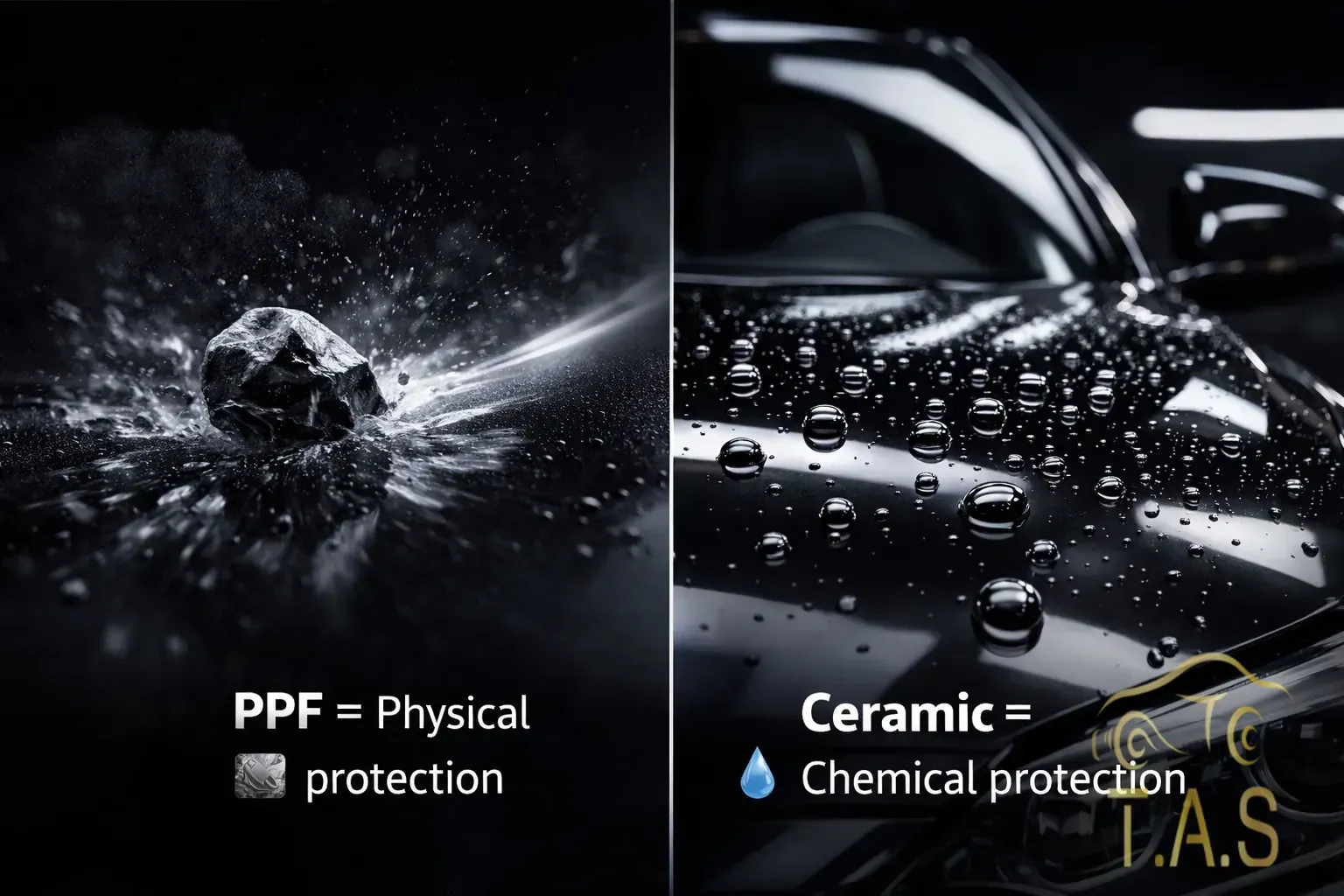
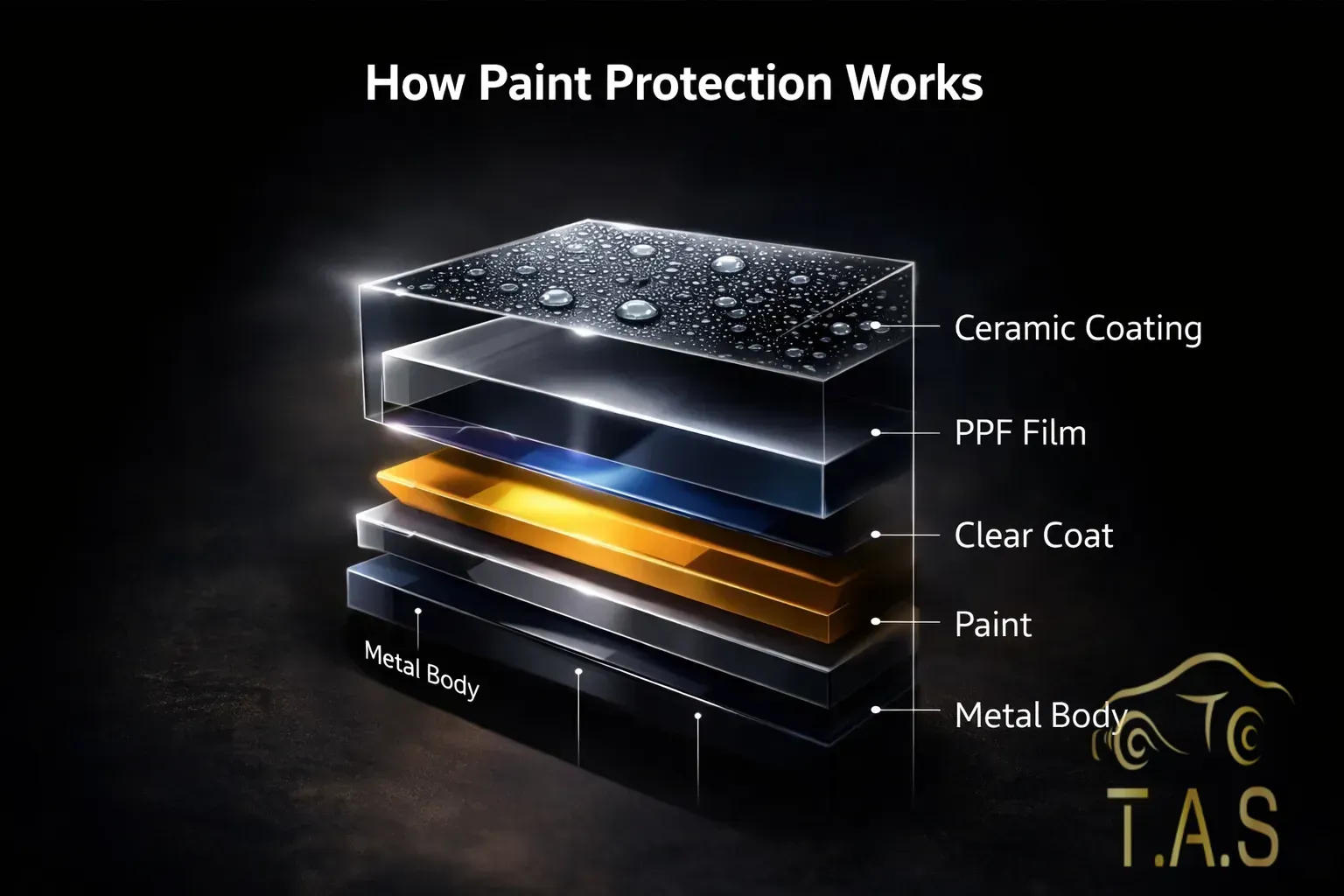
PPF (Paint Protection Film) is a thick urethane film — 150 to 200 microns — applied on top of paint. It absorbs physical impacts: stone chips, rock debris, minor scratches, and door dings. It is the only product that actually blocks chips.
Ceramic coating is a liquid polymer — 1 to 2 microns thick — that bonds chemically to your clear coat. It does not block physical impacts. What it does is create a hard, hydrophobic, UV-stable surface that resists chemicals, water spots, and contamination, and dramatically reduces cleaning effort.
Neither product is a replacement for the other. They solve different problems.
Full Comparison Table: PPF vs Ceramic Coating
| Property | PPF | Ceramic Coating |
|---|---|---|
| Core function | Physical impact absorption | Surface chemistry improvement |
| Chip and rock debris protection | Excellent — primary purpose | None |
| Scratch resistance | High | Wash-mark resistance only |
| Gloss enhancement | Good (gloss finish) | Excellent — deep, wet look |
| Hydrophobic behavior | Moderate unless topped with coating | Strong — 100°+ contact angle |
| UV protection | Good | Strong — UV-stable hard layer |
| Chemical resistance | Good | Excellent — pH 2–14 on premium tiers |
| Heat dissipation | None | Excellent in graphene variants |
| Self-healing | Yes in premium films | Yes in upper ceramic/graphene tiers |
| Thickness | 150–200 microns | 1–2 microns |
| Application area | High-impact panels (or full body) | Whole vehicle |
| Durability | 7–10 years (premium TPU) | 2–9 years depending on tier |
| Entry price at TAS (hatchback) | From ₹35,000 (partial) | From ₹12,000 (full car) |
What Does PPF Actually Stop?
PPF is the only car protection product that stops stone chips. Nothing else does. If you drive the NH66 between Trivandrum and Kollam, the NH85 through Eastern Kerala, or any highway with road construction debris, your front bumper and hood take chip impacts regularly. A premium ceramic coating cannot stop this — it only makes cleanup easier after the damage. PPF absorbs the impact before it reaches the paint.
This is the clearest use case for PPF: front-end chip protection on highway-driven cars.
Is Ceramic Coating Enough Without PPF?
For most daily drivers in Trivandrum city conditions — school runs, office commutes, moderate weekend use — ceramic coating alone is the right answer. City speeds produce fewer chip impacts. The main enemy in urban driving is UV, monsoon water spotting, industrial contamination, and swirl marks from poor wash technique. Ceramic coating addresses all of these. It also covers the entire vehicle affordably, where full-body PPF would cost 5–8x more.
Which Should You Choose for Your Car?
For the Tata Nexon or Hyundai Creta
These are high-volume daily drivers that typically see mixed city and highway use. The right strategy: graphene or ceramic coating for the full body (Graphene Pro or Ceramic Ultra depending on ownership duration) plus PPF on the front bumper and hood if you do regular highway runs. This gives chip protection where it matters and whole-car surface protection at a practical budget.
If the car stays primarily in the city, skip PPF and invest in a better coating tier — Graphene Ultra gives you more long-term value than partial PPF + entry ceramic.
For the Toyota Fortuner or MG Hector (Larger SUV)
A larger SUV needs larger panel coverage for meaningful chip protection. PPF on just the front bumper looks inconsistent and leaves the hood, mirrors, and fenders exposed. For Fortuners doing highway use in Kerala, we recommend either a full front clip PPF (bumper + full hood + side mirrors) or skipping PPF entirely and investing in Graphene Ultra Plus. The full front clip delivers real protection; half-measures on a large SUV rarely satisfy.
For Luxury Cars (BMW, Mercedes, Skoda Superb)
Full-body PPF topped with a graphene coating is the right answer. These cars have deep paint systems that react more visibly to chips and scratches, and the resale value calculation favors protection. Full-body PPF + graphene coating also simplifies maintenance because the hydrophobic top makes the PPF surface easier to clean.
What Is the Combo Strategy and Why Does It Work?
The most complete protection is PPF on high-impact panels + ceramic or graphene coating on the rest. This is not doubling up — they genuinely complement each other:
- PPF protects the front zones that face direct chip impact
- Coating on PPF panels improves hydrophobics and makes the film easier to maintain
- Coating on non-PPF panels (doors, roof, tailgate) gives UV and chemical protection
- The whole-vehicle gloss is consistent — PPF and coating finishes match when both are applied professionally
Combo Pricing at TAS: PPF + Coating Packages
| Vehicle Type | Front PPF (Bumper + Hood) | Full Car Coating | Combo Total |
|---|---|---|---|
| Hatchback (Alto, WagonR, Punch) | ₹35,000–45,000 | ₹15,000–22,000 | ₹50,000–67,000 |
| Compact SUV (Nexon, Brezza, Venue) | ₹40,000–55,000 | ₹18,000–28,000 | ₹58,000–83,000 |
| Mid-SUV (Creta, Seltos, Harrier) | ₹50,000–70,000 | ₹20,000–35,000 | ₹70,000–1,05,000 |
| Full-size SUV (Fortuner, MG Hector) | ₹65,000–90,000 | ₹25,000–45,000 | ₹90,000–1,35,000 |
| Luxury (BMW, Mercedes, Superb) | ₹80,000–1,50,000 | ₹35,000–65,000 | ₹1,15,000–2,15,000 |
Prices above reflect TAS packages as of 2025. Actual pricing depends on PPF film grade (self-healing TPU vs standard), coating tier chosen, and paint correction needed before application.
What PPF Film Grade Should You Choose?
Not all PPF films are equal. See our detailed PPF materials guide for the full breakdown, but in summary:
- Standard TPU — good chip protection, moderate clarity, no self-healing. Best for budget-conscious PPF buyers.
- Self-healing TPU — premium option with swirl and scratch resistance that repairs with heat. The right choice for luxury vehicles or anyone planning 7+ year ownership.
- Avoid PVC films entirely — PVC-based films yellow, crack, and haze within 2–4 years. They look like protection but fail under Kerala's UV load.
Related Service
Paint Protection Film Trivandrum — Self-Healing TPU Films
TAS uses only non-yellowing TPU films — standard and self-healing grades. Full front clip, partial, or full-body. Every installation includes paint correction and controlled curing.
Common Mistakes When Comparing PPF and Ceramic Coating
- Treating them as substitutes for the same problem — they protect against different damage types
- Buying PPF hoping it will improve gloss like a coating — it will not without a coating on top
- Buying ceramic coating hoping it will stop stone chips — it cannot
- Applying PPF on uncorrected paint — swirls are trapped permanently under film
- Choosing PPF installer based on price alone — installation quality determines whether edges lift, bubbles appear, or yellowing happens
Quick Decision Guide
| Your Situation | Best Strategy |
|---|---|
| City driver only, keep 2–4 years | Ceramic Ultra (full car) |
| City driver, keep 5+ years | Graphene Ultra or Ultra Plus (full car) |
| Mixed city + highway, keep 3–5 years | Front PPF + Graphene Pro |
| Highway-heavy, keep 5+ years | Front clip PPF + Graphene Ultra |
| Luxury car, any use pattern | Full-body PPF + Graphene Ultra Plus |
| Brand new car, maximum protection | Full-body self-healing PPF + Graphene Ultra Plus |
Still not sure? The answer depends on three inputs: where you drive (highway vs city), how long you keep the car, and whether chips or surface damage is your bigger concern. Visit TAS Detailing in Maruthankuzhi, Trivandrum for a free 10-minute consultation.
Want package-level guidance instead of theory? See our PPF service page for front-end, full-front, and full-body options.
Related Service
Ceramic Coating Trivandrum — 4 Tiers from ₹12,000
Compare Ceramic Shield, Guard, Ultra, and Ultra Plus. Every package includes controlled application, IR curing, and professional paint prep.
Related Service
Paint Protection Film Trivandrum — Partial and Full Body
Self-healing TPU PPF at TAS. Front bumper, full front clip, or full-body options. Installed in a controlled, dust-free environment with warranty documentation.