PPF Materials Explained: PVC vs TPH vs TPU — Which Film Should You Choose?
What Is PPF Made Of — and Why Does the Material Matter?
Paint Protection Film (PPF) is a surface layer applied over car paint to absorb stone chips, minor scratches, and debris impacts. What most buyers do not realise is that "PPF" is not a single material — it is a product category. The film inside the package can be made from three entirely different polymer bases: PVC, TPH, or TPU. These materials behave very differently in real use.
Understanding the material helps you avoid buying a film that looks like protection but ages poorly in Kerala's conditions.
What Is PVC PPF — and Why Should You Avoid It?
PVC (Polyvinyl Chloride) is a lower-cost plastic historically used in protective films and wraps. In the automotive aftermarket, PVC-based films are generally considered a lower-end option because they tend to age less gracefully than better polyurethane-based films.
PVC PPF: What it does - Provides basic impact protection against small stones and debris - Low cost — cheapest film available
PVC PPF: What it cannot do - **Can yellow or haze faster** under heat and UV exposure than better-quality polyurethane-based films - **Cannot self-heal** — scratches are permanent - **Can become less flexible over time**, especially in harsh heat and outdoor exposure - **May show earlier edge-aging or adhesive issues** than better-quality films - **Usually offers lower long-term optical stability**
Kerala's heat, humidity, dust, and UV exposure make long-term film stability more important than in milder climates. Lower-cost PVC-type films are generally less desirable in these conditions because they tend to lose clarity and flexibility sooner.
Practical takeaway on PVC: treat it cautiously. Low upfront price can come with weaker long-term appearance and durability.
What Is TPH PPF?
TPH is usually marketed as a hybrid material sitting between low-cost films and higher-grade polyurethane films. The exact chemistry and naming can vary by manufacturer, so buyers should treat "TPH" as a market label rather than a strict technical standard.
TPH PPF: What it offers - Better UV stability than PVC — significantly reduced yellowing risk - Some optical clarity improvement over PVC - More affordable than full TPU films - Acceptable entry-level protection for lower-impact use cases
TPH PPF: Its limits - **Self-healing is inconsistent** — some products offer limited self-healing, others do not - **Durability varies significantly by manufacturer** - **Usually does not match premium TPU films** in long-term clarity, stretch, or topcoat performance - **May be less conformable** on difficult curves than higher-grade polyurethane films
TPH sits in a practical middle position: often better than the lowest-end films, but usually not as refined or proven as premium TPU systems. It can be a budget-conscious option if the brand, warranty, and installer quality are credible.
What Is TPU PPF — and Why Is It the Standard?
TPU (Thermoplastic Polyurethane) is widely used in premium automotive PPF products because it offers a strong balance of clarity, flexibility, impact resistance, and compatibility with modern self-healing topcoats.
TPU PPF: Core properties - **Better long-term optical stability** than lower-grade alternatives - **Self-healing topcoat** on premium grades — light scratches disappear with heat (sun or warm water) - **Usually thicker and tougher** than low-cost films, helping with impact absorption - **High conformability** — stretches cleanly around complex panel shapes and edges - **Often backed by longer premium warranties** - **Optically clear** — high-quality TPU is invisible on dark or light paint when installed correctly
TPU PPF: Two grades within TPU
| Grade | Self-Healing | Hardness | Best For |
|---|---|---|---|
| Standard TPU | No | Moderate | Chip protection, budget-conscious PPF buyers |
| Self-healing TPU | Yes (heat-activated) | High | Swirl and scratch prevention, premium cars, long-term ownership |
Self-healing TPU is the top tier: the elastomeric topcoat means light scratches from brushing, car wash contact, or fine debris disappear when the surface warms up. For anyone keeping a car 6+ years or owning a luxury vehicle, self-healing TPU is the right choice.
Full Comparison Table: PVC vs TPH vs TPU PPF
| Property | PVC | TPH | TPU (Standard) | TPU (Self-Healing) |
|---|---|---|---|---|
| Core material | Polyvinyl chloride | Thermoplastic hybrid | Thermoplastic polyurethane | TPU + elastomeric topcoat |
| Yellowing / haze risk | Higher | Lower than PVC, but varies | Lower | Lower |
| Self-healing | No | Product-dependent | Usually no | Usually yes |
| Thickness | Varies widely | Varies widely | Varies by product | Varies by product |
| Conformability | Lower | Moderate | High | High |
| UV stability | Lower | Moderate to good | Better | Better |
| Typical warranty trend | Shorter / inconsistent | Mid-range / varies | Longer | Longer |
| Optical clarity | Hazes with age | Acceptable | High | High |
| Impact protection | Basic | Moderate | Strong | Strong |
| Recommended for Kerala | Caution | Depends on brand and warranty | Usually yes | Usually preferred |
| Entry price at TAS (partial) | Not offered | On request | From ₹35,000 | From ₹45,000 |
These comparisons are directional rather than universal. Actual performance depends on the specific film, topcoat system, adhesive, installer skill, and warranty backing.
Why Kerala's Climate Makes Material Choice More Critical
PVC and lower-grade films generally struggle more in harsh outdoor use than better polyurethane-based films. In a hot, humid, high-UV environment like Kerala, that gap tends to matter more because clarity retention, adhesive stability, and topcoat quality are stressed year-round.
This is why buyers should prioritize film quality, warranty terms, and installer credibility over the lowest headline price.
How Do You Identify What Film a Shop Is Selling You?
One of the most important questions to ask any PPF installer is: "What is the base film type, and which exact product are you installing?"
A credible installer should be able to name the product, explain the warranty, and provide a product data sheet or warranty document. If they cannot clearly identify the film, that is a warning sign.
Other checks: - Ask for the warranty card/certificate — legitimate brands issue trackable warranties - Ask whether the film is self-healing, and under what conditions - Ask about film thickness and topcoat, but do not rely on thickness alone as a quality test
TAS PPF Film Range
At TAS Detailing, we position TPU-based films as the preferred option for customers who want stronger long-term clarity, durability, and warranty support. Our installations include:
- Standard TPU — strong chip and impact protection with better long-term stability than lower-grade alternatives
- Self-healing TPU — premium grade for luxury vehicles and long-term ownership; light scratches self-repair with heat
Both options include paint correction before installation, controlled dust-free application, and warranty documentation.
Related Service
Paint Protection Film Trivandrum — Non-Yellowing TPU Films
Self-healing and standard TPU PPF at TAS. Partial, front clip, and full-body options. Dust-free installation with warranty. Trivandrum's established PPF installer since 2013.
Common Questions on PPF Film Material
My current PPF is yellowing — what film was it? Yellowing or haze usually points to film aging, topcoat breakdown, lower-grade material, or long-term environmental exposure. It is more common in lower-grade films than in premium TPU products, but the exact cause depends on the product and its condition. If the film is visibly aging, replacement is usually the cleanest solution.
Is self-healing worth the premium over standard TPU? For many long-term owners, yes. The self-healing topcoat helps reduce the visibility of light wash marks and minor surface marring. For shorter ownership or tighter budgets, standard TPU may still be a reasonable choice.
Can I apply ceramic or graphene coating on top of PPF? Yes, many installers offer this. A coating on top of PPF can improve hydrophobic behavior and make maintenance easier. Whether it is worth doing depends on the film, the coating, and the owner's maintenance goals.
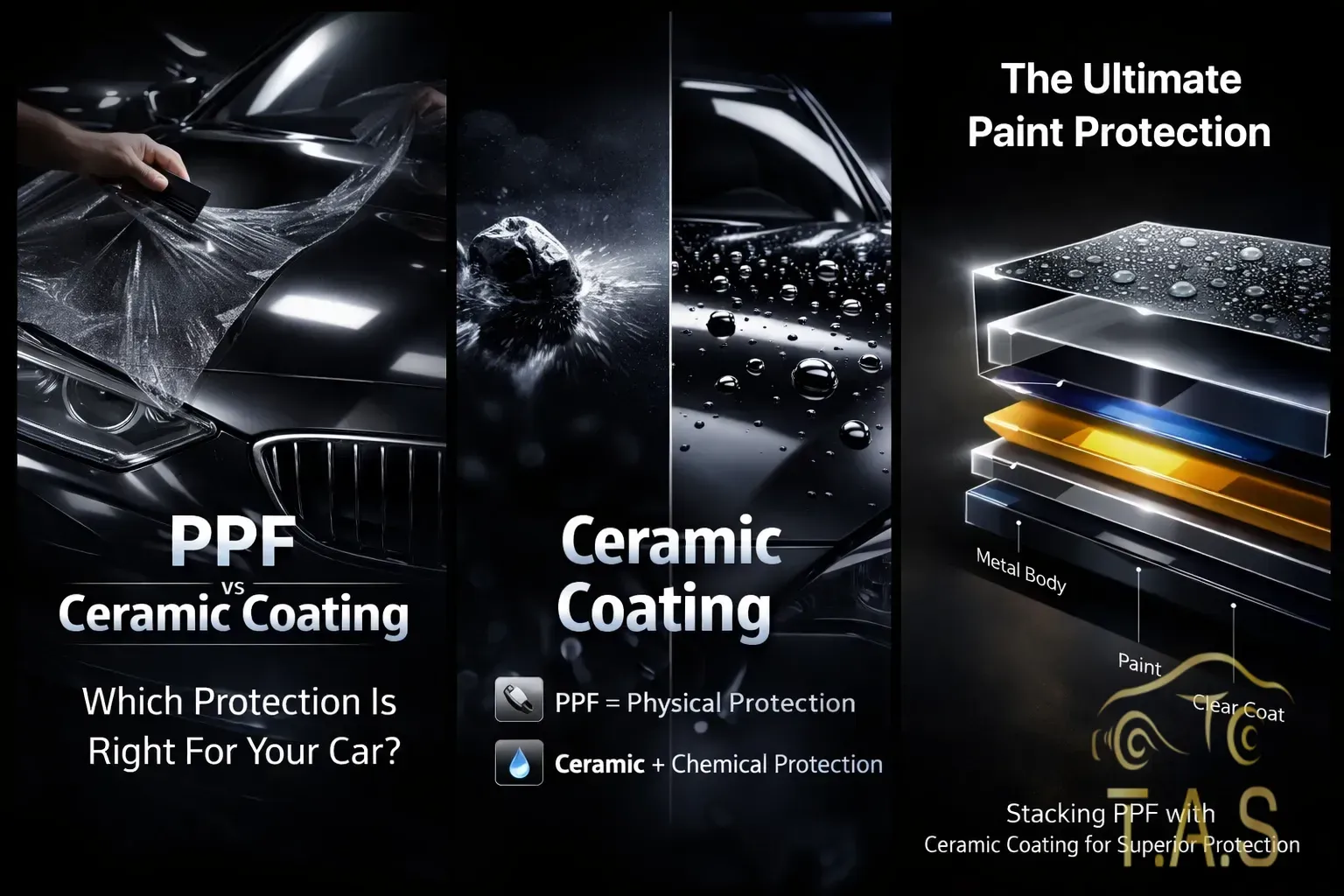
Does full-body PPF replace ceramic coating? No. They do different jobs. PPF blocks physical impact. Coating improves surface chemistry, hydrophobics, and UV resistance of the surface layer. Full-body PPF without coating still benefits from having a coating applied on top.
Quick Decision: Which PPF Film Should You Buy?
| Your Situation | Right Choice |
|---|---|
| Budget-focused, want real chip protection | Standard TPU from a credible brand/installer |
| Planning to keep car 5–7 years | Standard TPU — possibly self-healing |
| Luxury car, any ownership duration | Self-healing TPU |
| New car, want maximum long-term protection | Self-healing TPU + graphene coating on top |
| Budget buyer, chips are not your main concern | Consider coating instead of low-grade film |
| Current PPF is yellowing | Remove and replace with TPU |
The material decision is the most important PPF decision you make. Premium installation on a poor film is a waste. The right material, installed correctly, is what gives you the best chance of strong long-term clarity and chip protection.
Ready to choose the right film for your car? View our main PPF service page for package options, pricing ranges, and installation workflow.
Related Service
Graphene Coating Kerala — Combined with PPF
TAS graphene packages from ₹18,000. Ideal applied over PPF for combined impact + surface chemistry protection. Graphene Ultra Plus is our top-tier offering with Elite GSO2 formula.