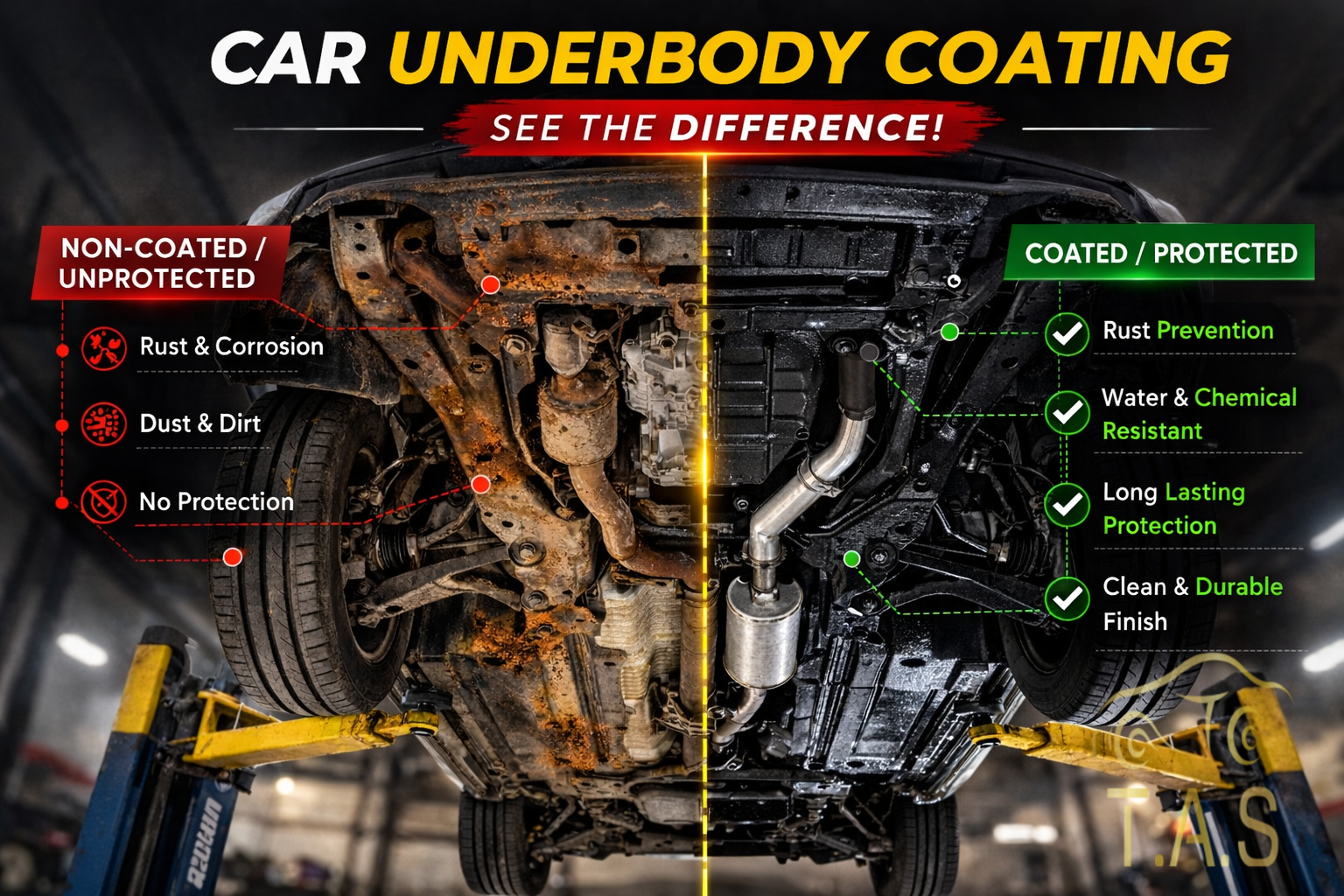
Car Underbody Coating
Kerala's roads, rain, and coastal humidity are hard on your car's underbody. Our underbody coating service applies a thick rubberized black coat to every exposed metal surface beneath your car — sealing it against rust, moisture, and stone chips. Add the silencer package for a heat-resistant silver coat on your exhaust system. Built to last 5+ years.
Tailored Packages for Every Need
Underbody Rust Shield
- Full underbody pressure wash & degrease
- Rust inhibitor treatment on existing spots
- Thick rubberized black coating — all exposed underbody metal
- Protects floor pan, chassis rails, wheel arches, and suspension mounts
- Noise dampening effect
Underbody + Silencer Guard
- Everything in Underbody Rust Shield
- Heat-resistant silver coating on exhaust / silencer
- Protects against exhaust corrosion and heat damage
- OEM-matching silver finish on silencer
- Complete underbody protection in one visit
Note: Package details, features, pricing, and availability are subject to change. Please contact us directly to confirm the latest inclusions, pricing, and slot availability before booking.
Booking note: Prior booking is required for this service. Please contact us in advance to confirm availability and reserve a slot.

Complete Service Overview
Car Underbody Coating — Complete Rust Protection for Kerala's Roads
Kerala's monsoon, humidity, and coastal environment are among the harshest conditions for a car's underbody. Factory coatings wear off within a few years — our rubberized underbody coating adds a durable 5+ year layer of protection.
What Does Underbody Coating Protect?
- Floor pan — the largest flat metal surface beneath the passenger cabin
- Chassis rails — structural members running the length of the car
- Wheel arches — constantly exposed to water, mud, and gravel
- Suspension mounting points — stress areas prone to corrosion
- Body seams and joints — where moisture collects and rust begins
The Silencer Coating Difference
The exhaust/silencer system runs at 300–600°C and is exposed to both heat and moisture — a combination that causes rapid surface rust and discolouration. Standard underbody coating cannot handle these temperatures. Our silencer package uses a high-temperature silver ceramic paint rated for exhaust surfaces, giving the silencer a clean, OEM-matching silver finish and corrosion protection.
Types of Underbody Coating — Why We Use Rubberized Polyurethane
Not all underbody coatings are equal. Here's how the main types compare:
- Wax-based undercoating — cheapest option, applies quickly, but wears off within a few months. Not suitable for Kerala's continuous moisture exposure.
- Bare asphalt / coal-tar coating — heavy rigid compound used on commercial trucks and heavy vehicles. Lacks flexibility and can crack on passenger car chassis at suspension flex points. Not the same as rubber-modified under-seal.
- Rubberized under-seal (rubber-modified bitumen) — the professional standard for passenger vehicles. Rubber content makes it flexible so it moves with the chassis without cracking. Excellent noise dampening, strong corrosion protection, and proven for tropical humid conditions. This is what TAS uses.
- Polyurethane underbody coating — synthetic flexible compound, slightly lighter than rubberized bitumen. A good alternative, particularly for tight areas around fuel lines and suspension joints.
- Oil-based undercoating — penetrates existing rust and slows further corrosion. Best as a pre-treatment or maintenance top-up, not a standalone primary coat.
TAS applies professional rubberized under-seal (rubber-modified bitumen) to all underbody panels, with a separate high-temperature ceramic paint on the silencer — the right material for each surface type.
Who Should Get Underbody Coating?
- New car owners (0–12 months) — apply before the factory coating wears off
- Pre-owned car buyers — protect before monsoon season
- Cars parked outdoors — especially in coastal or high-humidity areas
- Cars with visible underbody rust — we treat and coat, stopping further spread
- Frequent highway or off-road drivers — stone chip protection is essential
Common Questions
What is underbody coating and why does my car need it?
Underbody coating is a rubberized protective layer applied to the metal surfaces beneath your car — the floor pan, chassis rails, wheel arches, and suspension mounts. In Kerala's high-humidity and coastal environment, untreated underbody metal corrodes much faster than in drier climates. The coating seals the metal from moisture, road salt, and debris, preventing rust from forming. Most new cars have a thin factory coating that wears off within 2–3 years.
How long does underbody coating take?
The full process takes 2 days. Day 1 is preparation — pressure washing, degreasing, rust treatment, and masking. Day 2 is coating application and curing. We recommend dropping the car off early on Day 1 and collecting on Day 2 evening.
How long does the coating last?
Our rubberized underbody coating lasts 5–7 years under normal driving conditions. Kerala's monsoon and humidity are factored into our material choice. The coating does not peel, crack, or bubble — it flexes with the chassis.
What is the difference between the two packages?
The Underbody Rust Shield covers all exposed metal on the underbody with a thick black rubberized coat. The Underbody + Silencer Guard adds a high-temperature silver coating on your exhaust/silencer system, which is exposed to both heat and moisture and corrodes separately from the underbody. If your silencer shows discolouration or surface rust, the combined package is the right choice.
Does my new car need underbody coating?
Yes — factory underbody coatings on most production cars are thin and wear off within 2–3 years. Applying a proper rubberized coat at 6–12 months of ownership, before rust begins, is far more effective than treating rust later. For pre-owned cars, we inspect and treat existing rust spots before coating.
Will the coating affect brake lines or sensors?
No. Our technicians mask all brake lines, ABS sensors, oxygen sensors, exhaust hangers, and drain plugs before coating. Only bare metal panels that benefit from protection are coated.
Is silencer coating the same as underbody coating?
No — they are different materials. Underbody coating is a rubberized black compound for impact and corrosion resistance on chassis metal. Silencer coating is a high-temperature silver ceramic paint designed for exhaust surfaces that reach 300–600°C. Using the wrong product on the silencer will burn off quickly — which is why we use heat-rated material exclusively for exhaust coatings.
Is underbody coating worth it?
Yes — especially in Kerala. The cost of underbody coating is a fraction of what rust repair or chassis welding costs later. Once rust penetrates the floor pan or chassis rails, repair involves cutting and welding structural steel — easily ₹15,000–₹40,000+. A preventive coating done early protects the entire underbody for 5–7 years. It also reduces road noise and protects the vehicle's resale value. For cars driven in monsoon, coastal, or waterlogged areas, undercoating is one of the best-value services available.
What type of underbody coating does TAS use?
We use a professional-grade rubberized under-seal compound — a rubber-modified bitumen product engineered specifically for passenger vehicles. This is very different from cheap bare asphalt or coal-tar coatings used on commercial trucks. The rubber content makes it flexible, so it moves with the chassis without cracking, bonds firmly to bare metal, provides significant road noise dampening, and is proven for Kerala's monsoon and coastal conditions. For the silencer, we use a separate high-temperature ceramic paint rated for exhaust temperatures up to 600°C — a completely different material suited to the heat.
Related Services
Ready to Protect Your Car?
Get a personalized quote and expert advice for car underbody coating.